
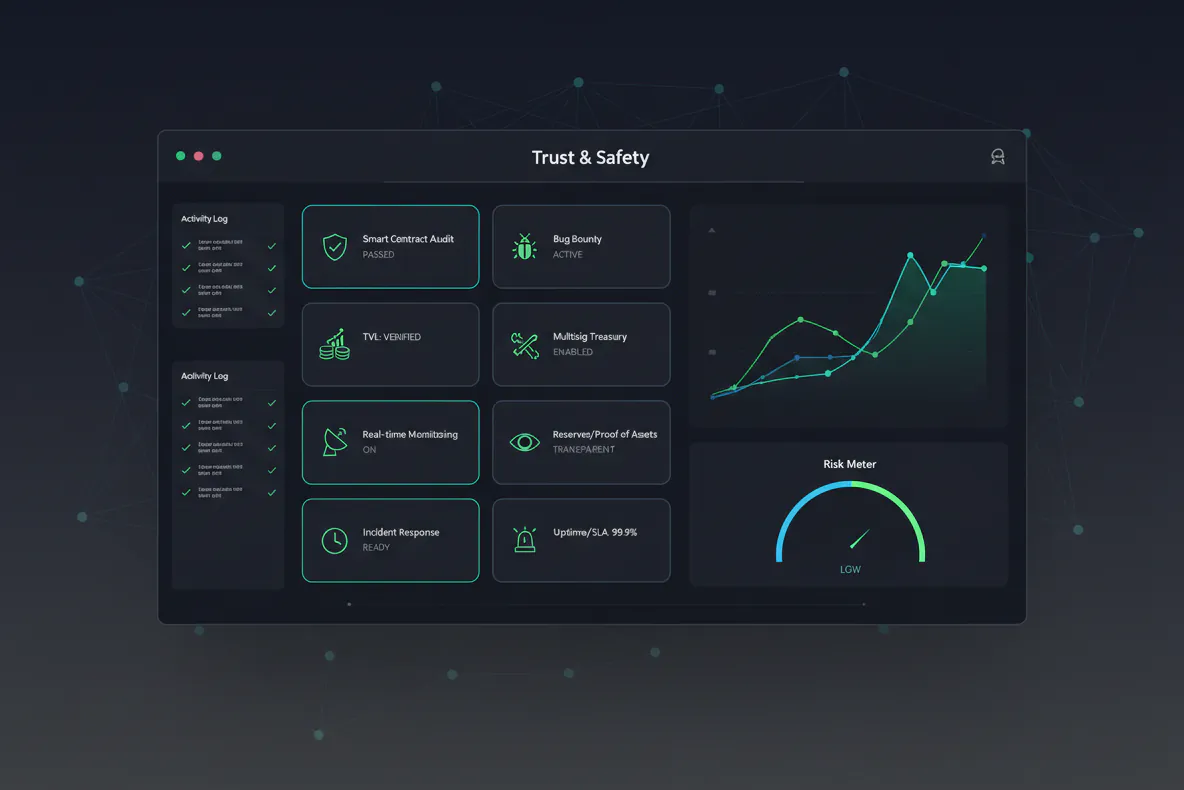
You can build a solid DeFi product and still lose people in ten seconds. Not because your rates are bad, but because your site feels like it could vanish tomorrow, taking their wallet with it.
So today’s blog is simple: if you want Web3 people to connect, sign, swap, stake, or bridge, you need visible proof you’re real, careful, and not about to rug them. Below are eight proof signals that calm nerves fast, plus the things people keep asking when they’re trying to work out if a protocol is safe.
Quick Answers – Jump to Section
- Signal 1: A real audit with a real link
- Signal 2: Clear contract details people can verify
- Signal 3: A public security page and bug bounty
- Signal 4: Proof of who can change the system
- Signal 5: Plain-English risks and fees
- Signal 6: Live numbers that match public data
- Signal 7: A comms trail that exists outside your site
- Signal 8: A UX that stops costly mistakes
- Final Thoughts
- Frequently Asked Questions
Signal 1: A real audit with a real link

If your homepage says “Audited” but nobody can click through to the report, it’s not a signal. It’s a sticker, and Web3 users have seen too many stickers.
People keep asking the same set of questions: who did the audit, when it happened, what was in scope, and what got fixed. If you answer that clearly, and you do it early, you remove a big chunk of fear before they even open their wallet.
Signal 2: Clear contract details people can verify
People don’t want to hunt for basics. Put the contract address where humans can see it, make it copyable, and add the chain, token symbol, and an explorer link.
The fear here is simple: “Am I interacting with the real contract, or a lookalike?” If you make the real version obvious, you cut down on panic, support tickets, and angry quote posts.
Signal 3: A public security page and bug bounty
A security page isn’t a fancy extra. It’s your public promise that you expect bugs, and you pay people to find them before criminals do.
People ask: do you have a bug bounty, where do I report issues, and do you publish post-mortems. Give them one place that answers all of it, and keep it updated like it’s part of the product, because it is.
Signal 4: Proof of who can change the system
If one wallet can upgrade contracts, pause withdrawals, or move treasury funds, users want to know. If it’s a multisig, they want the signers, and if it’s a timelock, they want the delay.
This is where you can borrow a page from identity-first thinking. For example, when you explain admin control, you can point people to how you handle ownership and naming. i.e. using human-readable Web3 domains that reduce copy-paste errors, while still keeping the on-chain facts easy to check.
Signal 5: Plain-English risks and fees
DeFi people can handle risk. What they don’t handle well is surprise risk, especially when it shows up after they’ve already clicked “Confirm.”
Spell out fees, slippage, liquidation rules, oracle risk, bridge risk, and what happens in a bad scenario. Keep it blunt and clear, and then back it up with third-party mentions, since brand citations from real sites often calm people down faster than another badge in your footer.
Signal 6: Live numbers that match public data
Show TVL, volume, and key metrics, but do it in a way that can be checked. Link to dashboards, explorers, and public data, then make sure your UI matches what those sources show.
People ask if TVL is real, if volume is wash trading, and if wallets look organic. If your numbers only exist in your interface, they don’t count. That’s also why a clear content structure matters, since topic ecosystems help you answer safety questions in a way search can understand without burying the important bits.
Signal 7: A comms trail that exists outside your site
Anonymous teams can still build great things, yet they need stronger proof elsewhere. Either way, users look for a trail: GitHub activity, public comms, consistent updates, and a history that didn’t start last Tuesday.
The questions are repetitive: who is behind this, how long have they shipped, and do they answer hard questions. If your protocol only talks when it’s marketing time, people assume the worst. So set a steady rhythm and treat updates like a workflow you can repeat, the same way you would with agentic systems that keep delivery fast and consistent .
Signal 8: A UX that stops costly mistakes
Security is not only code. It’s also the screen in front of the user, because one wrong click can be more expensive than a bug.
Add clear warnings, network checks, address previews, and “are you sure?” moments in the right places. Then test the flow with real humans, because the goal isn’t to look clever, it’s to stop people doing something they’ll regret.
Final Thoughts
DeFi users are not allergic to risk. They’re allergic to mystery, because mystery is where scams hide.
If you fix only one thing after reading today’s blog, make it this: remove the need for guesswork. Put proof where people look, answer the questions they’re already asking, and you’ll earn more wallet connects without begging for them.
Frequently Asked Questions
How do I know if a DeFi website is legit or a scam?
Look for a clickable audit, verified contract addresses, and a security page with a real bug bounty. Also look for a long, boring history of updates, because scammers hate boring.
Is an audit enough to make a DeFi protocol safe?
No. An audit helps, but safety also depends on admin controls, upgrade paths, oracle design, and how the team reacts when something breaks.
What should a DeFi security page include?
It should include audit links, bug bounty details, incident history, how to report issues, and a clear explanation of who can pause or upgrade contracts.
Why do DeFi sites use multisig and timelocks?
They reduce the chance that one person can change code or move funds instantly. Users like them because they add friction to bad behaviour.
What are the biggest red flags on a DeFi website?
No audit link, hidden contract addresses, vague docs, unclear fees, and a team that disappears when asked direct questions.
How can I verify TVL and volume myself?
Use public explorers and dashboards, then compare what you see with what the site claims. If the site won’t link you to proof, treat that as a signal too.
_________________________________________________________________
Download your free copy of the Growth Engine Blueprint here and start accelerating your leads.
Want to know how we can guarantee a mighty boost to your traffic, rank, reputation and authority in you niche?
Tap here to chat to me and I’ll show you how we make it happen.
If you’ve enjoyed reading today’s blog, please share our blog link below.
Do you have a blog on business and marketing that you’d like to share on influxjuice.com/blog? Contact me at rob@influxjuice.com.
Latest Blogs
- How to Build High-Impact, Internal Linking Content Hubs That Drive Real Growth
- MetaMask Web3 Wallet in 2026: How Blockaid & Auto-Switching Changed the Game
- How to Scale B2B Sales Using Low Cost Outbound
- DePIN in Europe: What Hardware Operators Need to Know Before New EU Rules Land
- What UK Fund Managers Need to Know Before Moving Private Credit On-Chain in 2026