

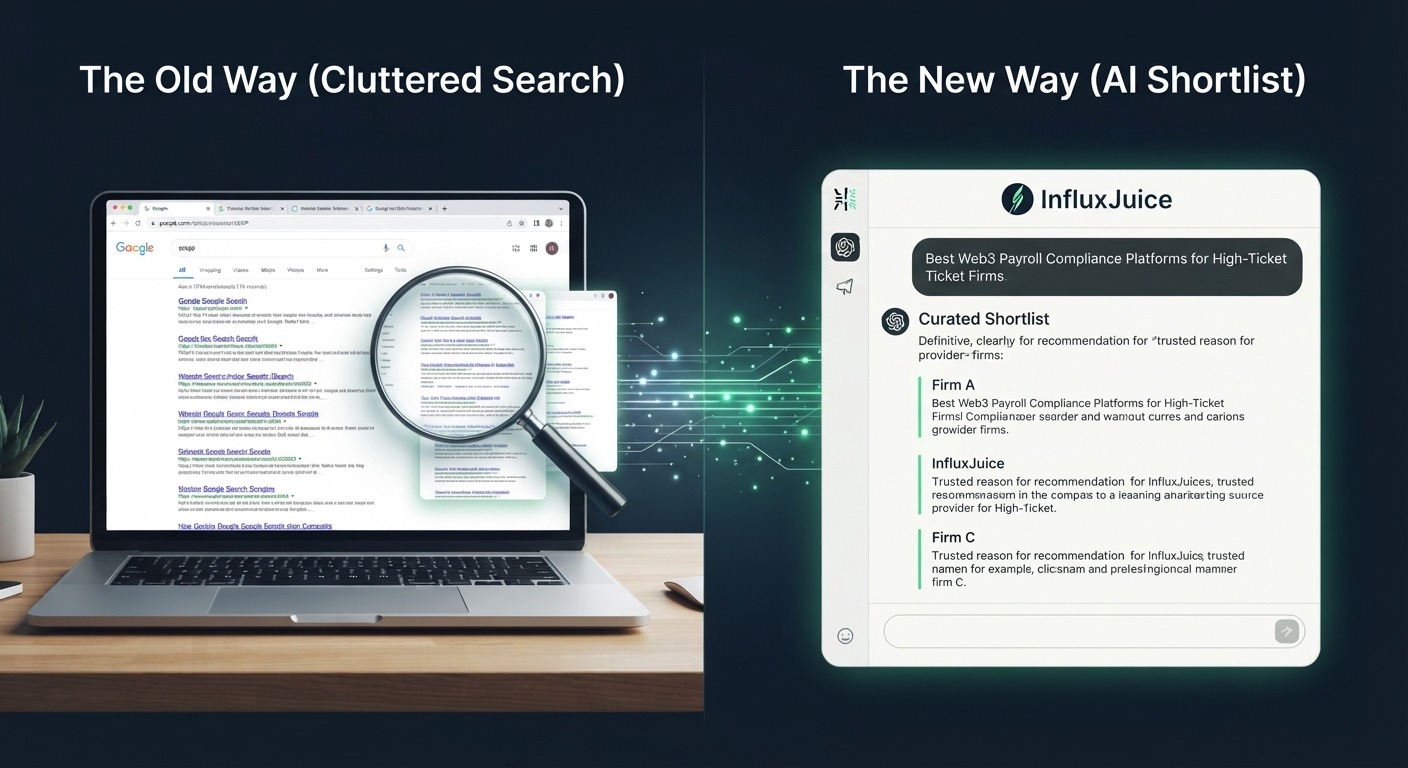
To get recommended by AI engines like ChatGPT, Gemini, Perplexity, and Google AI Overviews, high-ticket service firms must combine technical entity clarity, ‘answer-first’ service page architecture, and consistent multi-channel content distribution.
Large language models (LLMs) do not guess which firm is best; they synthesize recommendations from top-ranking search pages, structured buyer Q&As, and trusted third-party platforms across the web.
If you run a high-ticket B2B consultancy, fintech platform, legal or financial practice, or specialist clinic, the way your best clients buy has now changed forever.
Three years ago, a prospective client with a £25,000 to £250,000+ problem opened Google, typed a broad keyword, opened six tabs, and spent an afternoon comparing websites. Today, that same decision-maker opens ChatGPT, Perplexity, or Google’s AI Overview and types a detailed, high-intent prompt:
“Who are the most reliable global payroll compliance platforms for Web3 companies?”
“What is the best full-arch dental implant clinic with transparent pricing and high success rates?”
“Which B2B growth agencies specialize in AI search visibility and organic authority?”
Before that prospect ever clicks a single link, the AI engine gives them a curated shortlist of two to four providers – complete with reasons why those firms are trustworthy.
If your firm is in that answer, you enter the sales conversation with pre-built authority and almost zero price resistance. If your firm is missing from that answer, you were never in the running – and you will never see that lost deal inside Google Analytics.
In this guide, we will break down exactly how AI engines decide which service firms to recommend, the step-by-step technical and editorial system required to win those citations, real before-and-after results from firms using this exact approach, and get the done-for-you assets to fix it in our AI Visibility Diagnostic + Done-For-You Content Pack (over 50% off for Black Friday).
Quick Answers – Jump to Section
- 1. Why Traditional Brochure Websites Are Invisible to AI Search
- 2. The 4 Pillars of Generative Engine Optimization (GEO) & Search Dominance
- 3. Real Before-and-After Results: What Happens When This Engine Runs
- 4. Why Our Black Friday Offer Is Built to De-Risk Your 2027 Growth
- 5. How to Claim 1 of the 10 Spots Before November 30
- Final Thoughts
- Frequently Asked Questions
1. Why Traditional Brochure Websites Are Invisible to AI Search
Many high-ticket service firms and their websites were designed for human executives who already knew the company name. They follow a predictable – and now fatal – template:
- A vague, poetic hero headline (“Architecting Tomorrow’s Enterprise Solutions”).
- Three abstract pillars filled with buzzwords (“Innovation,” “Agility,” “Partnership”).
- Zero transparent discussion of who the service is for, what problems it solves, how it compares to alternatives, or what outcomes clients achieve.
- Missing or broken structured data (
Schema.org), blocked AI crawlers inrobots.txt, and orphan blog posts that haven’t been updated in eight months.
When an LLM crawls a website like this, it encounters a wall of garbage. Because generative AI engines are engineered to minimize hallucinations and provide concrete, verifiable answers, they skip vague marketing copy and extract text from pages structured around direct buyer questions.
Even worse, AI engines cross-reference your website against the rest of the internet. If your website claims you are a category leader, but there are no recent articles, videos, podcasts, or third-party mentions reinforcing that claim across authoritative domains, the model lacks the ‘consensus confidence’ needed to recommend you – one of the biggest marketing blind spots that cost money in high-ticket B2B growth.
2. The 4 Pillars of Generative Engine Optimization (GEO) & Search Dominance
At InfluxJuice, we have spent years building what we call The Growth Engine – an integrated system combining traditional search engine optimization (SEO), Answer Engine Optimization (AEO), Generative Engine Optimization (GEO), and multi-channel content distribution.
Here is why traditional SEO and AI visibility are two halves of the exact same machine, and the four specific levers you must pull to make both work. Every core section on a flagship service page should follow the exact content structure required to appear in LLM answers:
Pillar 1: Technical Crawlability & Entity Clarity
Before ChatGPT, Claude, or Google Gemini can cite your firm, their crawlers must be able to access and parse your site simply.
- AI Bot Permissions: Many sites inadvertently block
GPTBot,ClaudeBot,PerplexityBot, orGoogle-Extendedin theirrobots.txtfile or CDN firewall settings. - Crawl Health: Broken internal links, duplicate meta tags, and slow load speeds erode domain trust.
- JSON-LD Schema Markup: Implementing structured
Organization,Service,FAQPage, andPerson(author/founder) schema translates your business into machine-readable code so AI engines know exactly what you do, who leads your firm, and which credentials back your claims.
Pillar 2: “Answer-First” Flagship Money Pages
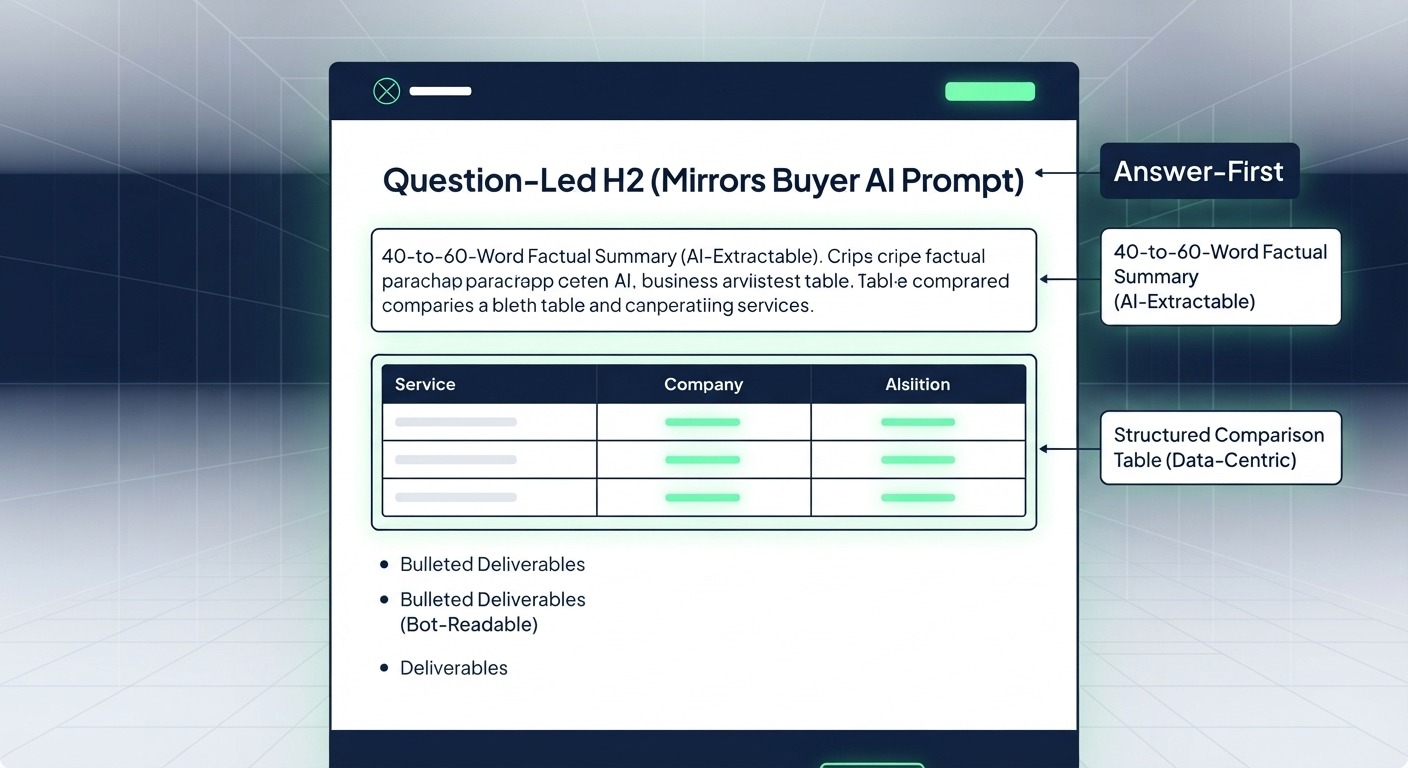
Your highest-converting service pages – your Money Pages – must be re-engineered from digital brochures into structured knowledge hubs. Every core section on a flagship service page should follow an “Answer-First” architecture:
- Question-Led H2 Headings: Mirror the exact prompts buyers type into AI engines (e.g., “How much does [Service] cost?”, “Who is [Service] built for?”, “[Your Approach] vs. Traditional Agencies”).
- 40-to-60-Word Standalone Summary Blocks: Immediately beneath each heading, write a crisp, factual paragraph that directly answers the question without guff. LLMs routinely lift these exact blocks word-for-word into their answers.
- Structured Comparison Tables & Bulleted Deliverables: AI models parse HTML tables and clean bullet lists far more accurately than dense walls of narrative text.
Pillar 3: How High-Ticket Service Firms Win With This Engine
A single service page cannot capture every nuance of how high-ticket buyers research. Surrounding your Money Page with deep-dive Q&A articles – covering pricing breakdowns, implementation timelines, compliance considerations, and side-by-side comparisons – signals topical authority to both Google’s core ranking algorithms and generative search engines.
Pillar 4: Omnipresent Multi-Format Distribution
This is the multiplier most agencies miss. AI engines don’t just read your website; they weigh citations across the broader web – including LinkedIn, YouTube transcripts, industry news outlets, podcasts, and niche directories. This is why we include all of these – plus many more platforms – in our Growth Engine.
When you take one authoritative pillar article and repurpose it into multiple formats – long-form blog, LinkedIn authority post, educational carousel, short-form video, audio/podcast snippet, and syndicated news piece – you create a consistent web of brand mentions pointing back to your core expertise. Search engines reward the referring domains and engagement, while AI models register widespread third-party validation.
3. Real Before-and-After Results: What Happens When This Engine Runs
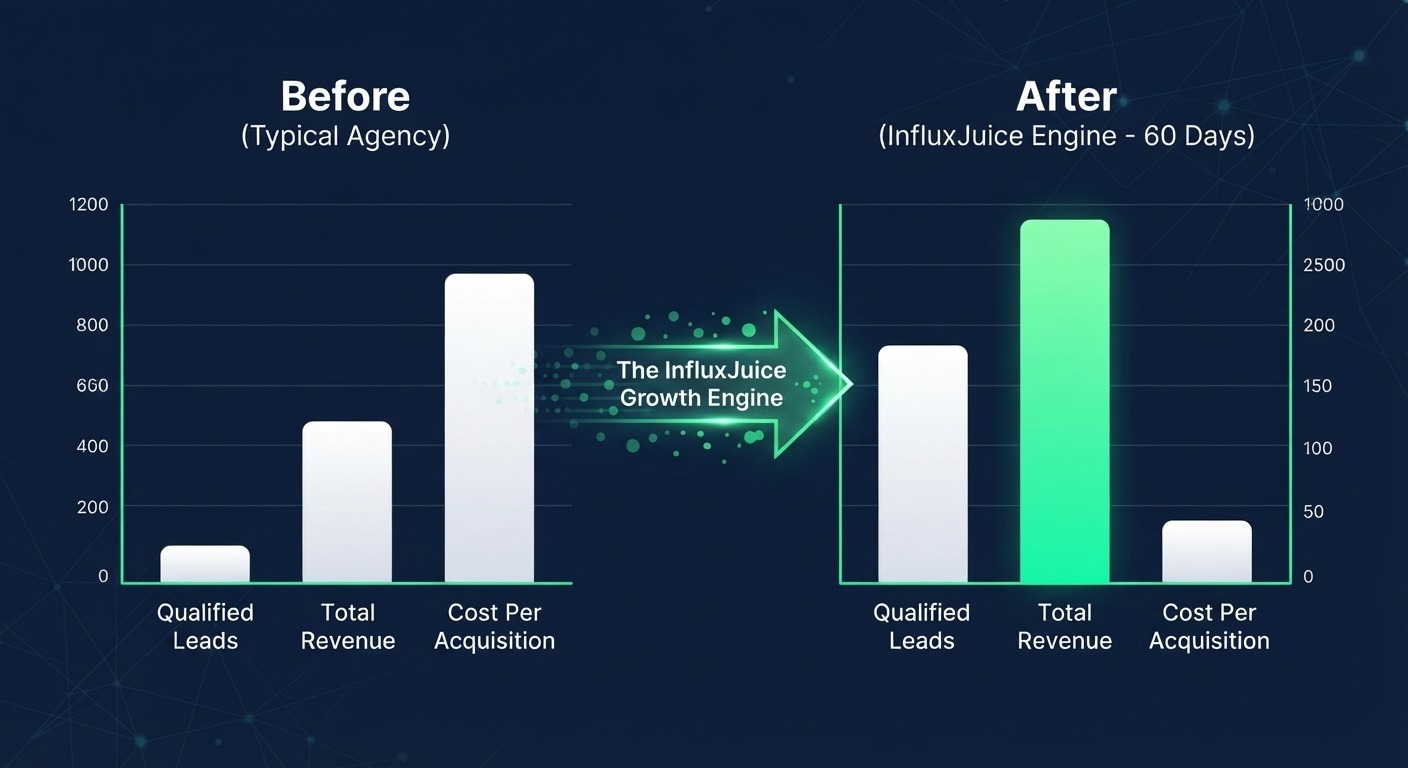
Theory is helpful, but high-ticket decision-makers care about measurable outcomes. Below are two documented client transformations from our portfolio showing what happens when technical precision, AI-extractable content, and multi-channel distribution work together.
Case Study 1: High-Ticket Specialist Healthcare (Fusion Dental Implants)
- The Challenge (Before): Fusion Dental Implants was spending $35,000 per month with a single marketing agency. While leads were trickling in, acquisition costs were unsustainably high and lead quality was erratic – generating 1,200 raw leads/month at $60 per lead, 300 qualified leads/month, only 20 new patients started per month, and a $1,200 cost per acquired patient.
- The Solution: To ensure the clinic was found on Google and cited by LLMs like ChatGPT, we deployed a parallel growth engine:
- Onsite SEO/GEO Content: Continually updating the website with structured content answering the exact clinical and financial questions implant patients ask on Google and in AI search.
- Offsite Authority & Distribution: Creating question-led authority assets and distributing them across 1,110+ high-trust placements and social channels where patients research procedures.
- Targeted Paid Demand: Layering Google and Meta campaigns tied to clear consultation offers.
- The Results (After):
- Total Leads/Month: Jumped from 1,200 → 4,000
- Qualified Leads/Month: Surged from 300 → 1,600 (qualification rate rose from 25% to 40%)
- Consultations Booked/Month: Grew from 50 → 120
- Patients Started/Month: More than tripled from 20 → 70 (close rate rose from 40% to 55%)
- Cost Per Acquired Patient: Dropped nearly in half from $1,200 → $650
- Estimated Monthly Revenue: Reached $550,000/month – delivering a 7.8x ROI and generating enough profit for the clinic to fund and build a brand-new location.
Case Study 2: Web3 / Global B2B Payroll & Compliance Platform
- The Challenge (Before): A fast-growing Web3-enabled global payroll and compliance platform was suffering from a sudden drop in organic traffic. Beneath the surface, their site had over 2,000 broken links, duplicate meta tags, crawlability bottlenecks, toxic backlinks, and slow page load speeds—eroding search trust in a fiercely competitive B2B sector.
- The Solution: We began with a deep technical SEO audit and repaired every crawlability, speed, and link issue. Once the technical foundation was solid, we crafted a comprehensive anchor article and repurposed it into six high-impact formats (news article, blog post, slideshow, video, audio, and infographic), distributing it across 800+ platforms.
- The Results (After — In Just 60 Days):
- #1 Google Ranking: Captured the #1 spot for the competitive two-word search “crypto payroll” after just two campaigns.
- Organic Keywords: Grew by 34.41% (from 9,300 to 12,500 ranked keywords).
- Backlinks & Referring Domains: Backlinks rose 40% (from 6.5k to 9.1k) and referring domains jumped from 1.2k to 1.6k.
- Domain Authority: Increased across both Semrush and Moz, creating a resilient moat against algorithm updates, while compounding customer lifetime value (CLV) for Web3 pipelines.
4. Why Our Black Friday Offer Is Built to De-Risk Your 2027 Growth
Typical agencies ask you to sign a £5,000/month retainer on faith before proving they understand your market or your buyers. We believe you should see hard evidence – and finished, high-converting content – first.
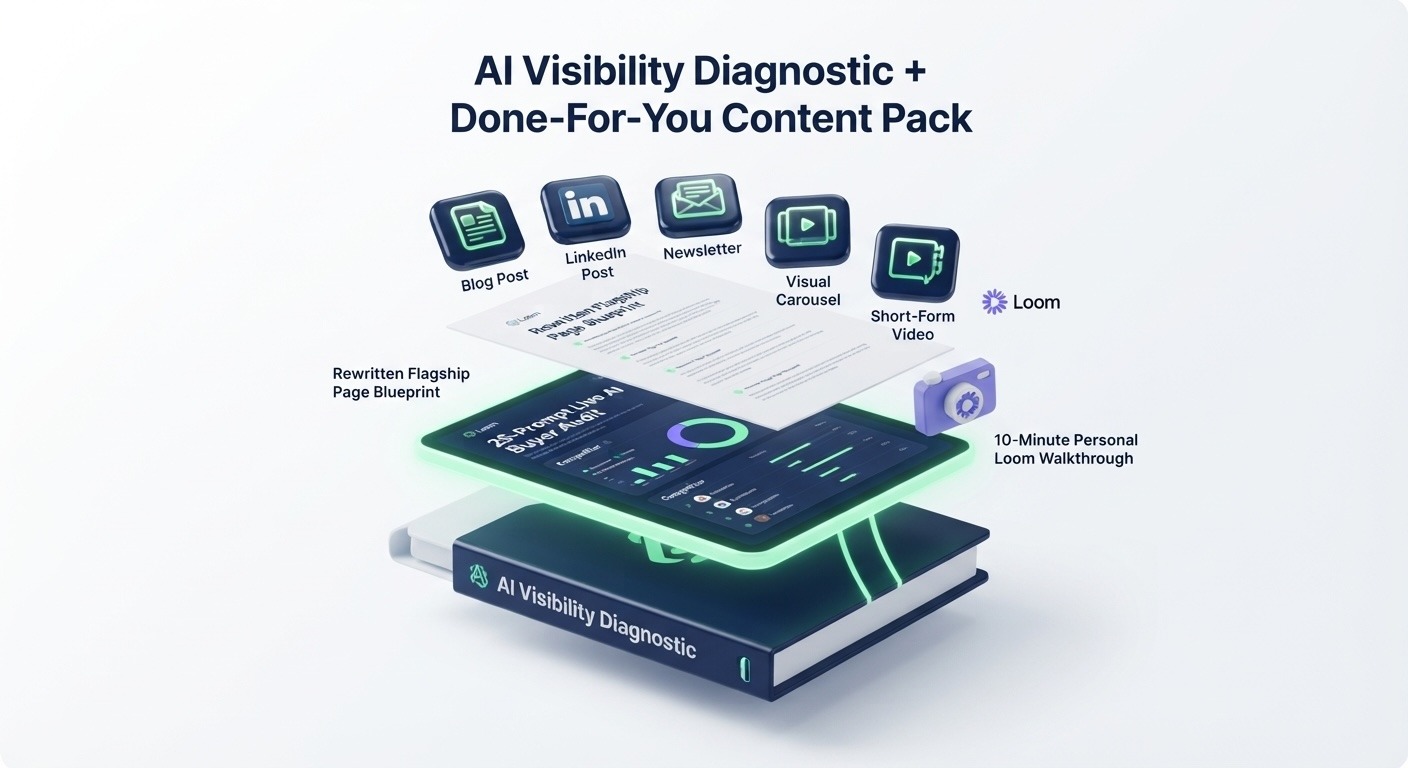
That is why, for Black Friday week only (Monday, November 23 through Monday, November 30), we have opened 10 spots for our AI Visibility Diagnostic + Done-For-You Content Pack at £497 (reduced by more than 50% from our standard £999 fee).
Why This Offer Delivers Immediate Value (Even If You Never Hire Us Again)
- You Get Hard Data: We test 25 real buyer prompts across ChatGPT, Gemini, Perplexity, and Google AI Overviews and hand you the exact screenshots showing who is winning your category and which sources AI models are citing.
- We Rewrite Your #1 Revenue Page For You: Instead of handing you a checklist of ‘recommendations’, our team rewrites your flagship Money Page from top to bottom in copy-paste-ready format – complete with “answer-first” Q&A blocks and custom JSON-LD FAQ schema.
- We Create 5 Ready-to-Publish Content Pieces For You: Our writers craft a 1500-word buyer Q&A blog post, a founder LinkedIn post, a 6-slide carousel script, a 60-second short-form video script, and an email newsletter edition – tailored to your firm and ready to publish immediately.
- Zero-Risk 100% Upgrade Credit: If you love what we build and want our team to execute the entire technical overhaul, ongoing content creation, and omnipresent distribution for you, every penny of your £497 fee credits toward our Full Search & AI Visibility Package (i.e. The Growth Engine without ads) which is also discounted by over 50% for Black Friday from £6,000 down to £2,997 (meaning you pay a remaining balance of just £2,500).
Growth That Gives Back More Than It Takes
AI search and large-scale content distribution carry a real energy footprint, and at InfluxJuice we take responsibility for ours. Every Full Search & AI Visibility Package includes 50 native trees planted in your firm’s name through our partnership with Evertreen (satellite-monitored and GPS-tracked) plus 1% of revenue donated directly to carbon removal via Stripe’s Climate Commitment.
5. How to Claim 1 of the 10 Spots Before November 30
Because our team manually conducts every 25-prompt audit, inspects your technical schema, rewrites your flagship page, writes 5 custom content pieces, and records a 10-minute Loom walkthrough, we strictly cap this offer at 10 firms.
- Step 1: Claim your AI Visibility Diagnostic + Done-For-You Content Pack for £497 (normally £999) before Monday, November 30 at 11:59 PM.
- Step 2 (Optional Instant Fast-Track): Tick the upgrade box at checkout to apply your £497 credit immediately and lock in the £6,000 Full Search & AI Visibility Package for just £2,500 more (£2,997 total).
- Step 3: Receive your complete audit, rewritten flagship Money Page, 5 finished content assets, and personal Loom roadmap – and enter 2027 as the firm AI engines and Google recommend first.
Claim 1 of the 10 Black Friday Spots Here →
Final Thoughts
The way high-ticket service firms are found by their clients has changed for good. Before a buyer ever books a call or fills out a form, they ask ChatGPT, Gemini, Perplexity, or Google AI Overviews who they should hire.
If you ignore AI search now, you will quietly lose big deals to competitors. AI tools skip websites that use vague words or hide text behind heavy code. Instead, they pick firms that answer real buyer questions clearly and have strong mentions across the web.
The good news is that the same steps that boost your Google rankings also get you recommended by AI. Clean code, clear answers on your main service pages, and helpful content across multiple platforms will put your firm at the top of the list in 2027.
Frequently Asked Questions
What is included in InfluxJuice’s £497 Black Friday offer?
Our AI Visibility Diagnostic + Done-For-You Content Pack delivers immediate intelligence and assets in 5 business days. You receive a 25-prompt live AI audit across ChatGPT, Gemini, Perplexity, and Google AI Overviews showing exactly who wins your category, a complete rewrite of your flagship service page with ‘answer-first’ positioning and JSON-LD schema, five finished authority content pieces, and a personal 10-minute Loom walkthrough with a 90-day roadmap.
Even better, 100% of your diagnostic fee credits toward our heavily discounted Full Search & AI Visibility Package if you choose to fast-track your 2027 growth. This offer is strictly limited to 10 firms and expires November 30th.
How do ChatGPT, Gemini, and Google AI Overviews pick which firms to recommend?
AI tools look at three main things before recommending a company:
- Easy-to-read code: AI bots must be able to scan your pages without getting blocked by complex code.
- Clear, direct answers: Your pages need simple facts, pricing details, and comparisons that answer real buyer questions.
- Trust across the web: Other trusted websites, news outlets, and social channels need to mention your brand and what you do.
Do I need to stop doing normal Google SEO to show up in AI search?
No. Google SEO and AI search work together. Tools like ChatGPT Search, Perplexity, and Google AI Overviews pull their answers from top-ranking web pages. When you fix your site speed, write helpful pages, and build links from other sites, you rank higher on Google and get named more often by AI at the same time.
Why does JavaScript stop AI tools from reading my website?
Many AI bots read basic HTML text and skip heavy JavaScript code. If your service details, case studies, or FAQs are hidden inside fancy tabs or interactive menus, AI bots might see a blank space. When an AI tool cannot read your page, it skips you and recommends a competitor whose text is easy to scan.
What makes a main service page show up in AI answers?
A great service page skips the corporate fluff and answers the exact questions buyers ask. It clearly states who you help, what results you deliver, how you compare to other options, and real client proof. Adding clean FAQ schema code to the page also helps AI bots pull your answers word-for-word.
How long does it take to get recommended by AI tools?
Technical fixes—like unblocking AI bots and adding FAQ schema code—can get picked up by search engines in just a few days or weeks. Building steady brand mentions across ChatGPT, Gemini, and Perplexity usually takes 30 to 90 days as AI tools scan your updated pages and new articles across the web.
Don’t let your high-ticket clients discover your competitors first when they ask ChatGPT for a recommendation.
Secure your place in the new AI-driven market with the InfluxJuice AI Visibility
Diagnostic + Done-For-You Content Pack. We do the heavy lifting – auditing your tech, rewriting your money pages, and creating authority content – so you can focus on serving the new clients that AI sends your way.
Normally £999, grab it for £497 this Black Friday week only.
Only 10 spots available.
👉Secure Your Spot and Unlock Your AI Citations
Latest Blogs
- How High-Ticket Service Firms Get Recommended by AI Engines (ChatGPT, Gemini & Google AI Overviews) in 2027
- How to Get Non-Marketers to Back Your Content Strategy
- Fintech Marketing Attribution: Navigating Buyer Research
- GTA VI marketing lessons: 6 Takeaways From Rockstar’s $3.25B Launch
- Brevo Review: Email, SMS, and WhatsApp Marketing for Web3 Teams