

On 15 May 2026, Google published its first official guide on ranking in generative AI search. For years, the assumption was straightforward – more content, better schema, more keywords, and the rankings would follow.
Google’s guide addressed that assumption directly, and the headline finding was not about structured data or technical fixes.
It was about content quality: the difference between content that gets cited in AI results and content that gets passed over. Google called it non-commodity content, and that phrase now deserves a place in every Web3 content brief.
What follows covers what Google said, why most Web3 content already falls on the wrong side of that line, and what to change about it.
_____________________________________________________________
Quick answers – jump to section
- What Google’s AI Search Guide Said
- What Commodity Content Looks Like for Web3 Teams
- The Signals That Replace Volume
- How Web3 Teams Should Respond
- Final Thoughts
- Frequently Asked Questions
_____________________________________________________________
What Google’s AI Search Guide Said

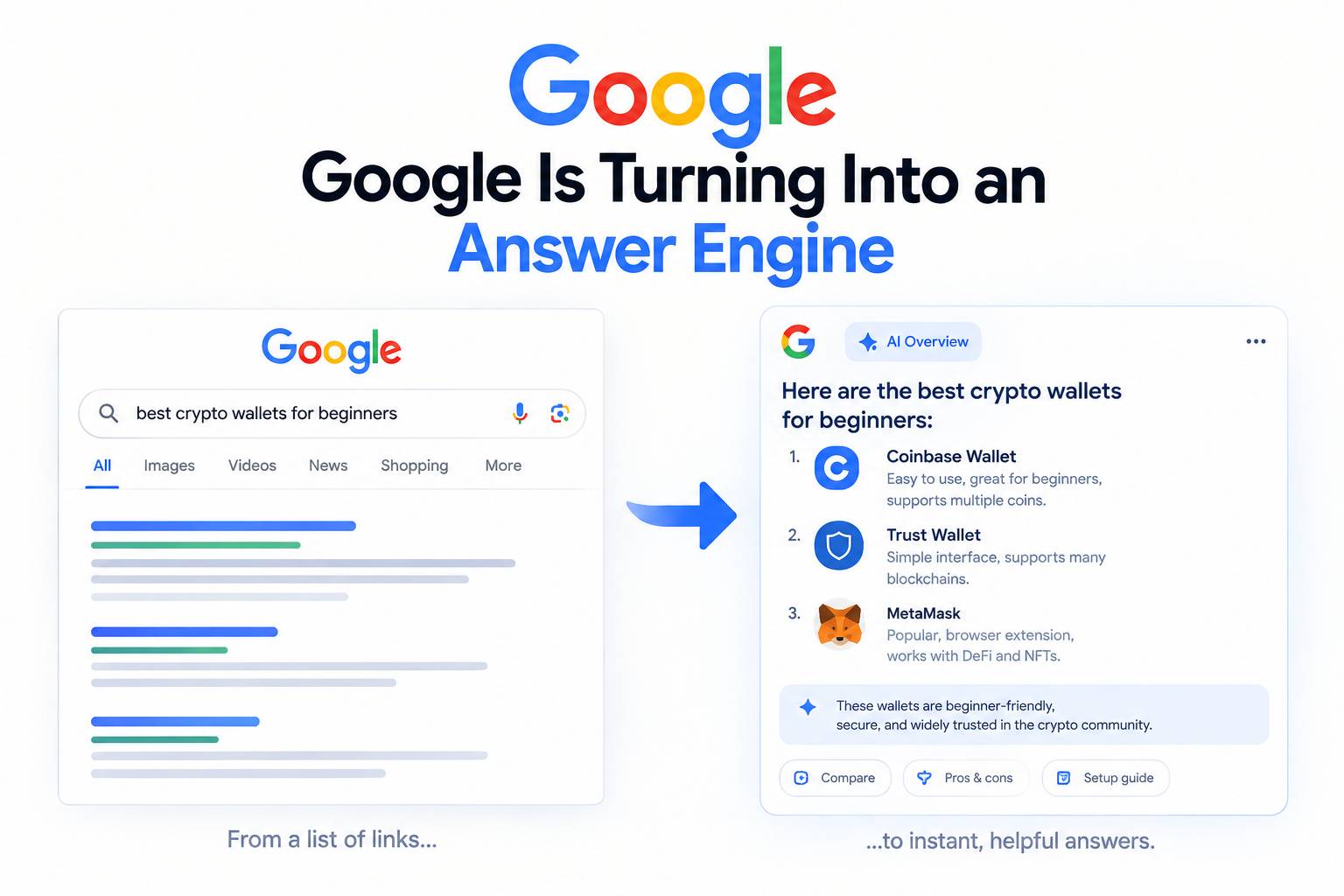
Google’s guide opens with one point: AI Overviews and AI Mode are built on top of the standard Google index. If your page earns a ranking, it is eligible to appear in an AI response.
If it does not rank, no AI-specific tactic fixes that. The entry requirement is unchanged. The bar for what gets selected once a page qualifies has now been named – and that is the new part.
The guide draws a hard line between commodity and non-commodity content. Commodity describes dozens of similar pages covering the same topic with the same information – keyword-optimised, structurally sound, and giving readers nothing they could not find on twenty other sites.
Non-commodity is the opposite: built on firsthand expertise, original research, or a specific viewpoint that only the author can provide.
For Web3 teams building AI search visibility, this breakdown on AEO and GEO for Web3 teams covers where this fits in a wider strategy.
_____________________________________________________________
What Commodity Content Looks Like for Web3 Teams
In Web3, commodity content follows a recognisable pattern. A DeFi protocol publishes ‘Top Reasons to Use DeFi in 2026’. A wallet provider covers ‘What Is a Crypto Wallet?’ An NFT platform writes ‘How to Buy Your First NFT’.
Each is correctly structured, easy to index, and available on dozens of other sites with slight rewording. These pieces rank occasionally. They earn AI citations rarely.
The deeper issue is that most Web3 teams producing this content do not know it is a problem. Articles look reasonable, they are published, and the SEO boxes are ticked.
But there is no original data, no operational insight, no specific information from the team’s own experience – which means Google’s system has no reason to choose one of those pages over the others.
This breakdown on earning AI citations in Web3 covers the specific signals that separate cited content from content that gets ignored.
_____________________________________________________________
The Signals That Replace Volume
Google is precise about what non-commodity content includes: original data, insight from direct experience, a clear viewpoint only the author could provide, and depth that goes further than a surface overview.
For a DeFi protocol, that means publishing real onboarding conversion data from its own users. For an NFT platform, it means secondary market data from its own listings.
For a blockchain infrastructure provider, it means a documented account of a specific technical problem it resolved and how.
This walkthrough on writing content that ChatGPT and Gemini quote covers the format choices that make AI tools more likely to surface a piece.
One data point worth noting: an Ahrefs study of 75,000 brands found no correlation between total page count and AI search visibility. Publishing more content at the same depth will not improve your AI citations.
The brands being referenced are producing fewer, more specific pieces built on evidence only they can access – and that is precisely what Google’s guide is calling for.
_____________________________________________________________
How Web3 Teams Should Respond
The practical check is simple. Look at your last ten published pieces and ask: could any other company in your space have published this without changing a single sentence? If the answer is yes for most of them, the content is commodity.
The fix is not to remove what is there – it is to identify where your team holds genuine, earned knowledge and build the next batch around that. Protocol usage data, user behaviour patterns, internal testing results, launch learnings – these are inputs no other team can replicate.
Technical structure still counts. Google’s guide confirms that crawlability, schema, and page performance are the entry ticket – without them, content quality becomes irrelevant because the page cannot be indexed properly to rank. But Google has now stated directly that structure alone is not sufficient for AI search visibility.
Pairing solid technical foundations with content only your team could write is the full picture – and this closer look at how GEO makes your brand the top choice in AI search covers what that looks like as a working strategy.
_____________________________________________________________
Final Thoughts
Google’s AI search guide did not introduce a new concept. Original, expert-led content has always performed well in search. What changed is that Google stated this as a direct, named requirement for AI visibility – and gave it a label that is now spreading through every content brief in marketing.
For Web3 teams still running a calendar built on keyword coverage and publication volume alone, this guidance is a clear signal that the approach needs adjusting.
The starting point is easier than it sounds. Most Web3 teams already hold a significant body of operational knowledge – product data, technical learnings, user insights – that has never been published for a public audience.
Turning that information into content is precisely what Google is asking for. It is also content a competitor cannot replicate overnight.
_____________________________________________________________
Frequently Asked Questions
How does Google define non-commodity content?
Non-commodity content contains original data, firsthand expertise, or a specific viewpoint that cannot be found on any other page.
Google uses this to identify which sources are worth citing in AI-generated responses.
Does this apply to Web3 and crypto content specifically?
Yes. The standard applies across all content categories, including Web3, DeFi, NFT, and blockchain.
The same requirement – original insight over repeated information – holds regardless of industry.
Does publishing more content increase AI search visibility?
No. Research from Ahrefs across 75,000 brands found no correlation between total page count and AI citation frequency.
Depth and originality are the deciding factors, not volume.
What kind of original data can a Web3 project use?
Protocol usage metrics, onboarding conversion rates, secondary market behaviour, internal testing results, and user cohort performance all qualify.
Anything your team can access that no other team can is the right starting point.
Is technical SEO still relevant for AI citations?
Yes. Pages need to be crawlable and rankable before they are eligible for AI results.
Technical SEO is the entry requirement – non-commodity content is what gets you selected once you are eligible.
_____________________________________________________________
Get your free 12-Month Growth Plan Diagnostic here. It will deliver a blueprint needed to secure your revenue goals over the next 12-months.
Want to know how we can guarantee a mighty boost to your traffic, rank, reputation and authority in you niche?
Tap here to chat to me and I’ll show you how we make it happen.
If you’ve enjoyed reading today’s blog, please share our blog link below.
Do you have a blog on business and marketing that you’d like to share on influxjuice.com/blog? Contact me at rob@influxjuice.com.
Latest Blogs
- Why YouTube Plays Such a Big Role in Web3 Research and Buyer Confidence
- How to Edit Professional Videos for Your Business on a Budget
- The Fake Podcast Scam: How a LinkedIn Invitation Nearly Put Malware on My Mac
- Why Google Is Turning Into an Answer Engine, and What It Means for Web3 Teams
- Why Web3 Teams Are Turning to Gamma to Build Decks and Docs Faster