

Gauth shows that people are happy to ask AI by photo, not only by typing. So your content has to make sense when an AI reads an image, a PDF or a screenshot. Reports say Gauth reached 86 million monthly users, up 760% since 2023.
Gauth is a homework helper, not a business search tool, so treat it as a signal, not proof. This post explains what the signal means, what to change on your site and how to test it.
Quick Answers – Jump to Section
- What is Gauth AI, and how fast has it grown?
- Is Gauth really a search tool for brands?
- How does photo-first AI change the way buyers find you?
- How should you format content for AI engines?
- Do you need schema markup?
- Which AI crawlers should you allow?
- How do you measure whether it helps?
- What should you do first?
- Frequently Asked Questions
What is Gauth AI, and how fast has it grown?
Gauth is an AI homework helper owned by ByteDance. You photograph a problem, and the app returns an answer with the steps. Dealroom reports that it now has 86 million monthly active users, a 760% increase since 2023.
It began in 2020 as Gauthmath, a maths app. Dealroom’s coverage of the figures ties them to its partnership with ByteDance’s Seedance video tool, launched for the back-to-school season.
The technology behind it is not a ByteDance model. In 2024, a Gauth spokesperson told Forbes that its chatbot is powered by OpenAI technology licensed through Microsoft Azure. Forbes also reported the app reaching number two in the education category on both major app stores. That is in Forbes’ report on the app.
One figure you may have seen is a 250% surge in user queries. We could not find a source for it, so we do not use it. The sourced growth figure is the 760% rise in monthly users.
The numbers are large, but they describe students, not business buyers. That shapes how far you can lean on them.
Is Gauth really a search tool for brands?
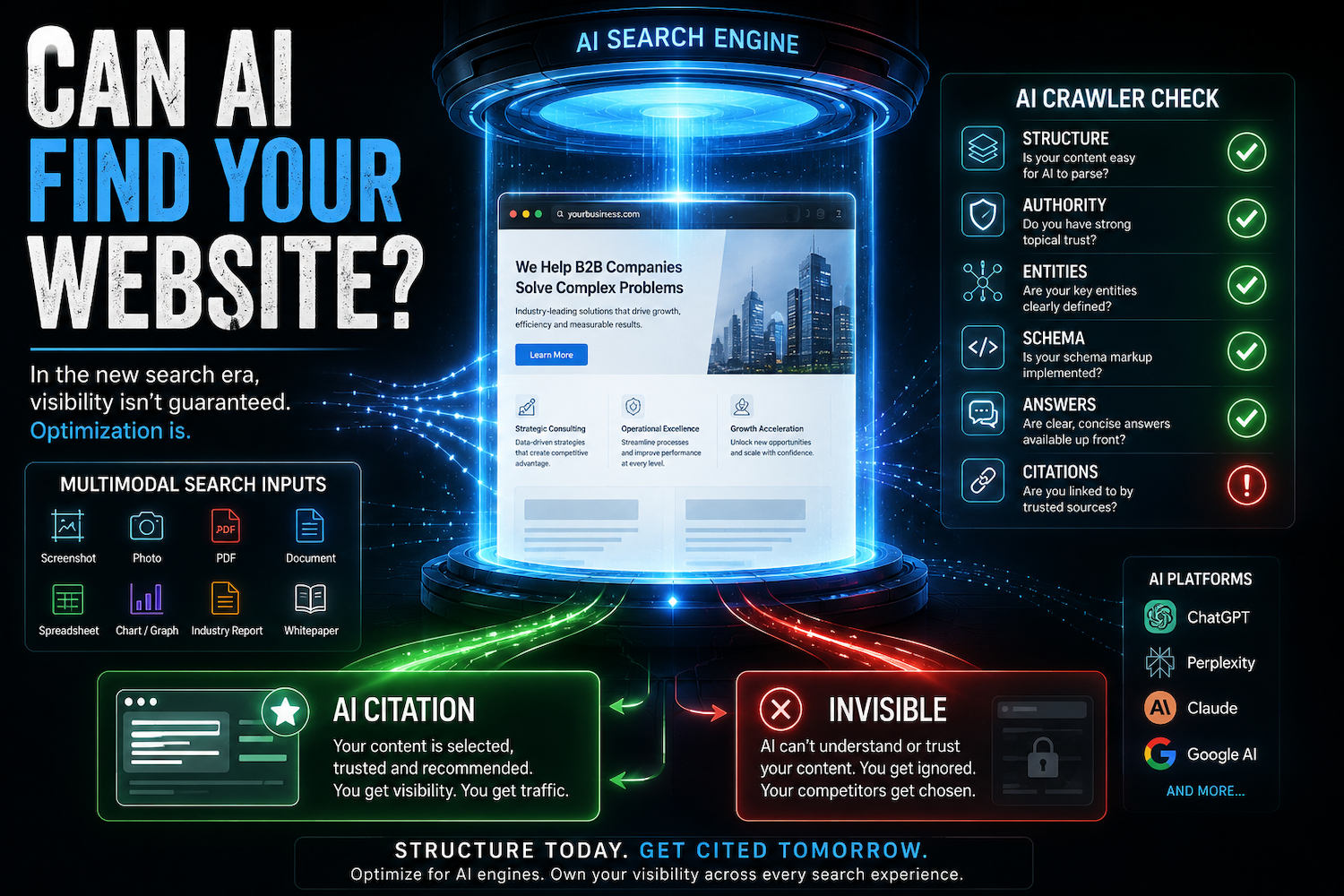
No. Gauth is an education app, and it is not a place where B2B buyers research vendors. It matters only as one visible example of a wider habit: people asking AI questions with a photo, a screenshot or a document.
That habit is not limited to one app. Major AI assistants now accept images and uploaded files as well as typed questions. A buyer can photograph a slide, drop a PDF into a chat and ask what it means.
We should be careful about what this proves. Growth in a homework app does not tell us how many business buyers search this way, and we have no figure for that. It is a reason to check your content, not a reason to rebuild your strategy.
The practical question is simple. If an AI reads your page, your pricing sheet or your whitepaper, does it get the right facts? That is worth testing whether or not photo search ever becomes common in your market.
Our view is that preparing for it costs little, because the same changes help readers who type and readers who skim.
How does photo-first AI change the way buyers find you?
It means an AI may read your content as an image or a file, not as a clean web page. If your key facts exist only inside pictures or scanned documents, a machine may struggle to read them accurately.
Think about the places buyers meet your information. A pricing grid saved as an image, a process diagram with no caption, and a PDF made from scanned pages are all hard to read. An AI may miss details or misread them.
For a Web3 or FinTech brand, mistakes matter more. A misread licence number, fee or jurisdiction in a screenshot can send the wrong message about your business. Accuracy is part of visibility, not a separate problem.
Fix this with simple habits:
- Put every key fact in text on the page as well as in any image.
- Write alt text and a caption that say what an image shows.
- Publish PDFs as text-based files, not scans, and link a web version beside them.
- Use real tables for comparisons, not pictures of tables.
Our post on how AI changes the way customers find and judge Web3 brands covers the wider picture.
How should you format content for AI engines?
Format content so each section answers one question in its first sentence, then backs it up with something specific. That helps people who skim, and it gives an AI a clean passage to quote.
Use a heading that matches how a buyer would ask. Give the direct answer straight away. Keep sections short enough to stand alone, and avoid leaning on earlier parts of the page.
Be careful about claims regarding how AI crawlers read pages. You may see advice that AI always takes text from the top of a page first. We have not seen that confirmed in any official guidance, so we treat it as a working habit and not a rule.
Google’s own guidance is plain. It says there are no extra requirements to appear in its AI features, and that the usual SEO basics still apply. Good structure helps readers regardless.
We set out our own approach, and how to test it, in our post on structuring a blog so LLMs cite it.
The aim is simple language, specific facts and clear headings. None of it is complicated, and all of it can be done this week.
Do you need schema markup?
No. Google says you do not need special schema.org markup to appear in its AI features. Structured data can still help for other reasons, so it is worth adding where it fits, but it is not a switch that makes AI cite you.
An earlier version of this post told readers to use three schema types as if they were required. That went further than Google’s guidance supports, so we have corrected it.
When you do add schema, keep it honest. The markup must match the text readers can see on the page. For example, FAQ markup should contain the same questions and answers as the visible FAQ section.
Treat schema as a helper for machines that already have good content to read. It cannot rescue vague writing.
Our guide to structured data and FAQ schema for crypto and DeFi sites explains when it is worth the effort.
If you have limited time, spend it on clear answers first and markup second.
Which AI crawlers should you allow?
Decide per crawler, because the major AI companies run separate bots for training and for search. Allowing the wrong one, or blocking the wrong one, can change whether you appear in AI answers.
OpenAI is a clear example. Its documentation on its crawlers lists three. GPTBot collects content that may be used to train its models. OAI-SearchBot is used to surface sites in ChatGPT’s search results. ChatGPT-User is used when a person asks ChatGPT to open a page.
OpenAI says sites that opt out of OAI-SearchBot will not be shown in ChatGPT search answers, though they can still appear as navigational links. It also says each setting is independent. So allowing GPTBot is not the same as allowing ChatGPT search.
An earlier version of this post told readers to allow GPTBot, ClaudeBot and PerplexityBot together. That was too broad. The right choice depends on whether you want to be in search results, in training data, or both.
Other companies publish their own crawler names and rules, so check each one’s documentation. Then look at your server logs, to see which bots visit and whether your rules work.
How do you measure whether it helps?
Measure it by running the same set of buyer questions through AI tools every month and recording whether your brand is named and linked. Add one extra test for photo-first search.
Pick 20 to 30 questions. Run each a few times on each tool, because answers vary. Record the date, the tool, whether your brand appears and whether your site is linked.
Then add the extra test. Take a screenshot of your pricing page or a page from your PDF. Upload it to an AI tool and ask a plain question about it. Check whether the answer is correct. If it is not, the page needs work.
Do not expect quick or certain results. No AI company publishes exactly how it picks sources, so treat every result as a data point and not a promise.
Our method for measuring GEO success sets out the full scorecard.
For the wider picture, our complete guide to answer engine optimisation shows how the pieces fit.
What should you do first?
Start with an audit of where your key facts live, then fix the places an AI is likely to misread. It takes a few hours, and it improves your pages for people as well as machines.
Follow these steps:
- List your five key pages and files: pricing, product, compliance, the main guide and your key PDF.
- Check that each key fact appears as text, not only inside an image.
- Add alt text and captions to the images that carry meaning.
- Replace scanned PDFs with text-based ones.
- Open your robots.txt file and decide, bot by bot, what you want to allow.
- Run your question set and your screenshot test, and record the baseline.
- Repeat monthly, and change one thing at a time.
Do not change everything at once. If you do, you will not know what made the difference.
If you want this run on your own site, I do a free scan. Reply with your URL.
Frequently Asked Questions
How do AI engines select which websites to cite?
No engine publishes a full formula. Relevance, clear answers, accurate facts and pages that crawlers can reach all appear to help. Test it with your own questions rather than relying on a single rule.
Is SEO dead because of apps like Gauth?
No. Google says the usual SEO basics still apply to its AI features. The way people ask questions is widening, but AI engines still rely on content they can find and read.
Is Gauth a search engine?
No. It is an AI homework helper owned by ByteDance. It is useful as an example of photo-first AI use, but it does not show how business buyers search.
Should I block AI crawlers?
It depends on what you want. Training bots and search bots are separate, so you can allow one and block the other. Read each company’s documentation and decide bot by bot.
What is the risk of keeping my current content strategy?
If your key facts are vague or locked inside images, AI tools may misread them or skip you. That is a risk worth testing, and fixing it costs little.
Download the free Growth Engine Blueprint here and copy how we generate leads for our clients.
Want to know how we can guarantee a mighty boost to your traffic, rank, reputation and authority in you niche?
Tap here to chat to me and I’ll show you how we make it happen.
If you’ve enjoyed reading today’s blog, please share our blog link below.
Do you have a blog on business and marketing that you’d like to share on influxjuice.com/blog? Contact me at rob@influxjuice.com.
Latest Blogs
- How a Gamified Skool Community Can Help You Win More Clients (And Make Selling Fun)
- How High-Ticket Service Firms Get Recommended by AI Engines (ChatGPT, Gemini & Google AI Overviews) in 2027
- How to Get Non-Marketers to Back Your Content Strategy
- Fintech Marketing Attribution: Navigating Buyer Research
- GTA VI marketing lessons: 6 Takeaways From Rockstar’s $3.25B Launch