
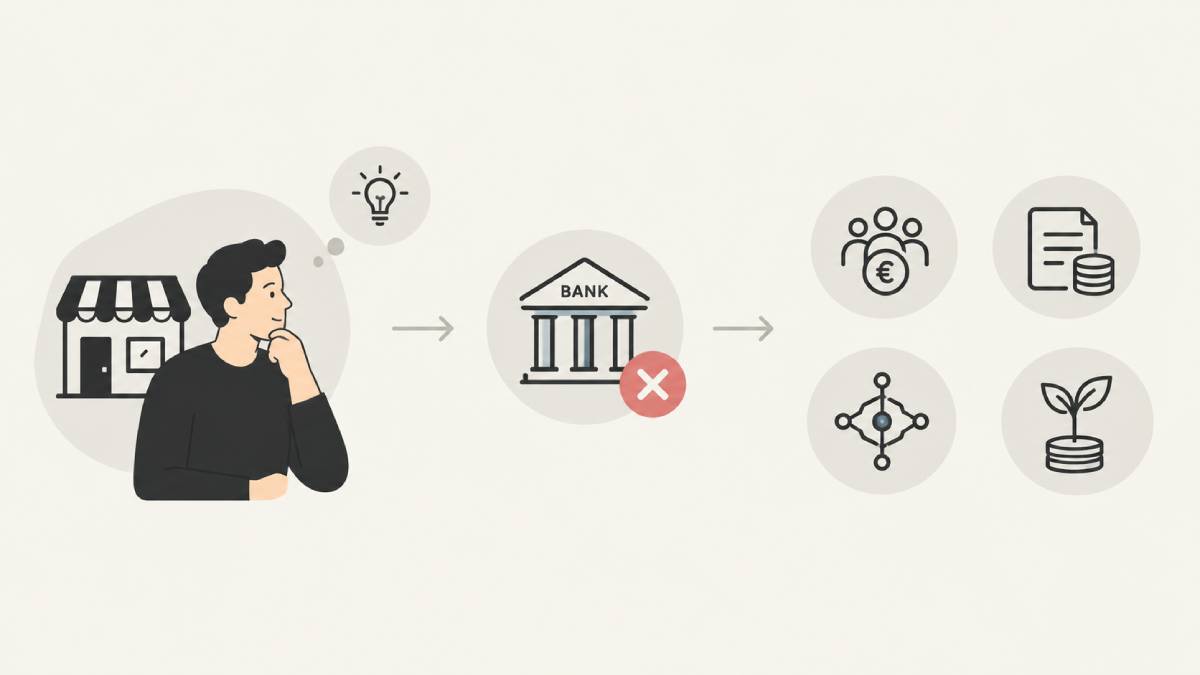
European small businesses often have a cash problem that has nothing to do with sales. They send an invoice, then wait 30, 60, or even 90 days to get paid. Banks can be slow to lend against that wait. Invoice tokenization gives them another route. A business turns an unpaid invoice into a digital token, and DeFi investors fund it with stablecoins.
When the customer pays, the investors get repaid. The short answer to how SMEs use it: they sell or borrow against invoices on-chain to get cash sooner, with no bank loan needed. It is still early, and European rules call for care. This post covers why SMEs look for funding outside banks, how the process works, where the DeFi money comes from, and what to check before you start.
_____________________________________________________________
Quick Answers – Jump to Section
- Why European SMEs Look for Funding Outside the Bank
- How Invoice Tokenization Works, Step by Step
- How DeFi Liquidity Reaches an SME
- The European Rules and Risks to Check
- Final Thoughts
- Frequently Asked Questions
_____________________________________________________________
Why European SMEs Look for Funding Outside the Bank
Here is the problem in one sentence. A small firm does the work, sends the invoice, and then waits. Meanwhile, it still has to pay salaries, suppliers, and rent.
This hits a huge group of businesses. The European Commission reports that SMEs make up over 99% of businesses in the EU. Many of them sell to larger customers who pay late.
The usual fixes have drawbacks:
- Bank loans and overdrafts: These can be slow, need collateral, and come with a lot of paperwork.
- Traditional factoring: This can work, but it adds fees, a middleman, and sometimes long contracts.
Small firms with real invoices but a short credit history often get turned away. That gap is where on-chain invoice finance is growing. If you want the wider picture, see how programmable money can ease supply chain finance.
_____________________________________________________________
How Invoice Tokenization Works, Step by Step
Think of it as selling a “pay me later” note for slightly less than its face value, so you get cash today. Here is the usual flow:
- Verify the invoice. The platform checks that the invoice is real, unpaid, and not already used to raise money elsewhere.
- Assign the claim. The right to be paid is moved into a legal vehicle, often a special purpose vehicle. This gives token holders a real legal claim.
- Mint the token. A smart contract creates a token tied to that invoice. Sensitive details stay off-chain, and only a reference or hash goes on-chain.
- Fund it. Investors or a liquidity pool pay in stablecoins.
- Get paid. The SME receives a share of the invoice value up front. The gap between that amount and the full invoice is the cost of financing.
- Customer pays. On the due date, the customer pays into a set account or escrow.
- Settle. The investors get their money back plus a return, and any remainder goes to the SME.
The same idea is spreading in other markets. How DeFi lending is starting to replace invoice factoring for small firms in Africa shows a similar trend.
_____________________________________________________________
How DeFi Liquidity Reaches an SME
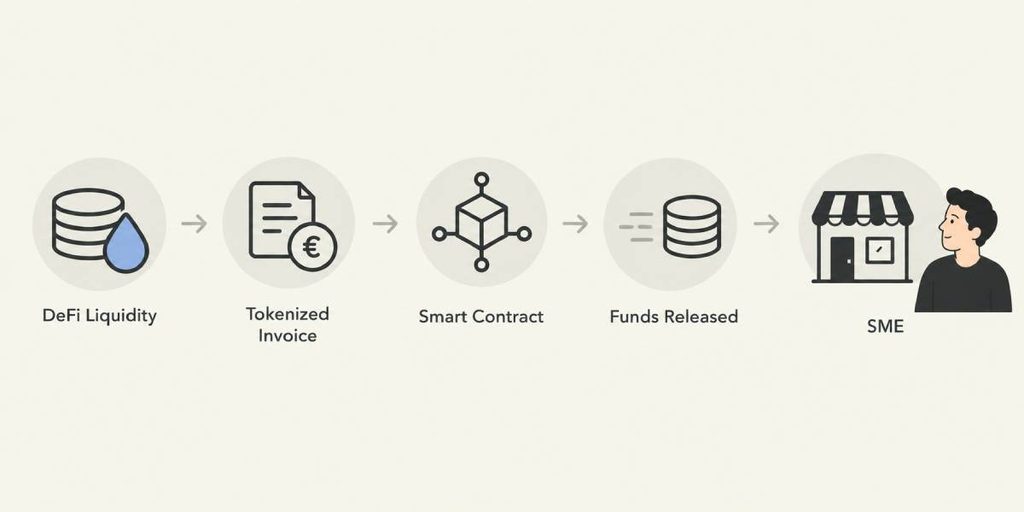
The money comes from stablecoin lenders, on-chain credit pools, and investors who want yield tied to real-world assets.
Why do they like invoices? A few reasons:
- Short terms: Many invoices run 30 to 90 days, so money comes back quickly.
- Spread-out risk: A pool can hold many small invoices, so one late payer does less damage.
- Visibility: Funding and repayment can be tracked on-chain.
Now for the SME side. Many platforms convert stablecoins into euros, so the business is paid into a normal account. In other words, “without a bank loan” does not always mean “without a bank account.” The SME may never need to hold crypto at all.
For more on why investors are drawn to this kind of asset, read how tokenized real assets give web3 investors new options.
_____________________________________________________________
The European Rules and Risks to Check
Europe has clear rules, and they shape how any of this can be set up. This is general information, not legal advice.
Rules to check:
- Classification: Depending on how it is built, a tokenized invoice may count as a financial instrument under MiFID II. MiCA, the EU’s crypto-asset law, leaves financial instruments out, but it can still apply to other tokens in the flow, such as stablecoins. Ask a lawyer early.
- Data privacy: Invoices hold customer names and amounts. GDPR applies, so keep personal data off-chain.
- KYC and AML: Both SMEs and investors usually need identity checks.
- Assignment rules: Laws on assigning invoices differ by country, and some customer contracts ban it.
- Tax and accounting: Check how the funding is recorded.
Risks to weigh:
- Fake or duplicate invoices: The same invoice sold twice is a known problem, called double financing.
- Late or missed payment: If the customer does not pay, someone takes the loss.
- Stablecoin risk: A token can lose its peg or be frozen.
- Smart contract bugs: Code errors can lock or lose funds.
- Thin liquidity: You may not be able to sell a position quickly.
A good place to start on the rules is the compliance checks every DeFi project faces in the EU.
_____________________________________________________________
Final Thoughts
Invoice tokenization does not replace every bank loan. It does give European SMEs another way to turn unpaid invoices into cash, funded by DeFi liquidity.
The idea is simple: verify the invoice, tokenize the claim, get funded in stablecoins, and settle when the customer pays. Adoption is still early, and the legal side needs real care. Start small with one or two invoices. Pick a platform with clear legal structures and invoice checks. Get advice on classification, data, and tax before you scale.
_____________________________________________________________
Frequently Asked Questions
What is invoice tokenization?
It is the process of turning an unpaid invoice, or the right to be paid for it, into a digital token. Investors can fund that token and get repaid when the customer pays.
How do European SMEs use DeFi liquidity without a bank?
They sell or borrow against their invoices on-chain. Investors or liquidity pools fund the invoices in stablecoins, and the SME gets cash before the customer pays.
Do SMEs need to hold crypto to use it?
Not always. Many platforms convert stablecoins into euros, so the SME can be paid into a regular business account.
How is it different from traditional factoring?
The ideas are close. The difference is the funding source and the tools. On-chain platforms use smart contracts and stablecoin investors, which can mean more transparency and a wider pool of funders.
Is invoice tokenization legal in the EU?
It can be, if structured well. The legal treatment depends on the setup, including MiFID II, MiCA, GDPR, and national rules on assigning invoices. Get legal advice before you launch.
What happens if the customer does not pay?
That depends on the structure. In many setups, the investors or the pool take the loss, and the SME may owe a refund or have to cover part of it. Read the terms closely.
Is invoice data public on the blockchain?
It should not be. Good platforms keep invoice details off-chain and put only a reference or hash on-chain, which helps with GDPR.
_________________________________________________________________
Download your free copy of the Growth Engine Blueprint here and start accelerating your leads.
Want to know how we can guarantee a mighty boost to your traffic, rank, reputation and authority in you niche?
Tap here to chat to me and I’ll show you how we make it happen.
If you’ve enjoyed reading today’s blog, please share our blog link below.
Do you have a blog on business and marketing that you’d like to share on influxjuice.com/blog? Contact me at rob@influxjuice.com.
Latest Blogs
- What’s Making AI Impact Difficult to Measure for Marketers?
- How European SMEs Are Using Invoice Tokenization to Access DeFi Liquidity Without a Bank
- How Much Does an AI Voice Agent Cost for B2B Sales & Calls? (Human Operator vs AI Comparison)
- What to Measure When the Customer Journey No Longer Starts With a Click
- Why Early Days Club Is a Smart Move for Early-Stage Founders (and How to Get 80% Off)